

As a water treatment material, coconut shell activated carbon performs a function that goes beyond simple “filtration.” More precisely, it serves as an adsorption medium that selectively removes specific components from water through physical and chemical processes. To understand how it works, one must first examine the fundamental physicochemical phenomenon of adsorption.
Adsorption refers to the phenomenon in which the concentration of molecules or ions within a fluid (in this case, water) increases at an interface (in this case, the surface of activated carbon). This process is driven by the nature of the forces acting between the surface of the adsorbent (activated carbon) and the adsorbate (impurities). The effectiveness of coconut-shell activated carbon is determined precisely by its unique microscopic structure.
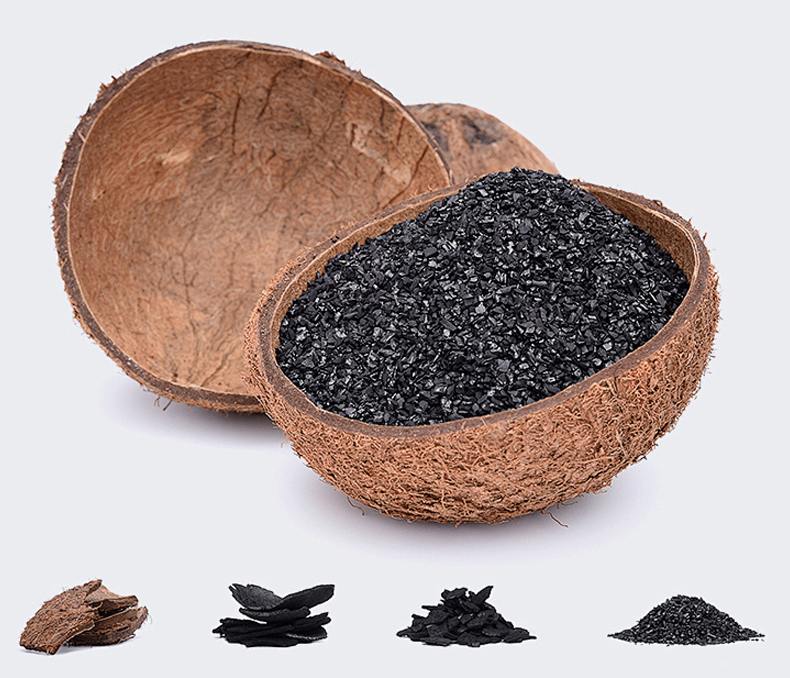
The microstructural characteristics of coconut shell activated carbon can be broken down into three levels, which form the physical basis for its adsorption capacity.
1. High specific surface area and pore structure. Through high-temperature carbonization and activation, coconut shells develop an extensive internal network of pores. These pores are categorized by size into macropores, mesopores, and micropores. Micropores—those with a diameter of less than 2 nanometers—account for the vast majority of the specific surface area; typically, a single gram of such activated carbon can possess a surface area exceeding 1,000 square meters. This immense surface area functions much like an expansive coastline, providing a vast number of “docking sites” for impurity molecules present in water.
2. Surface chemical properties. Although the primary component of activated carbon is carbon, its surface is not inert. During the activation process, oxygen-containing functional groups (such as carboxyl, hydroxyl, and lactone groups) as well as a small number of other heteroatoms are formed. These functional groups impart a weak charge or polarity to the surface of the activated carbon, enabling it to form specific bonds—via mechanisms such as hydrogen bonding or electrostatic attraction—with polar or ionic substances present in water (e.g., certain pigments, specific inorganic ions, and residual chlorine). This process falls under the category of chemisorption.
3. Pore size distribution and the molecular sieve effect. Coconut shell-based activated carbon is characterized primarily by micropores, with dimensions comparable to the kinetic diameters of many common organic pollutant molecules (such as benzene, toluene, and certain pesticide residues). This correspondence gives rise to a “molecular sieve” effect: molecules of an appropriate size can enter the pores and become firmly adsorbed, while molecules that are too large (such as certain microorganisms or colloids) or ions that are too small (such as sodium, calcium, or magnesium ions) are excluded. This is the key to its selective adsorption capability.
Based on the aforementioned structure, the adsorption principle of coconut shell activated carbon in water treatment manifests as a synergy between two primary mechanisms.
Physical adsorption—also known as van der Waals adsorption—is a ubiquitous phenomenon. It occurs primarily within micropores and is driven by van der Waals forces, which exist between all molecules. Although these forces are relatively weak, their extremely short range of action—combined with the material’s vast specific surface area and well-matched pore dimensions—results in a substantial total adsorption capacity. This mechanism is highly effective at removing odor-causing molecules (such as those responsible for earthy/musty smells or the odor of hydrogen sulfide) as well as certain small-molecule organic compounds.
Chemical adsorption, by contrast, is more selective. For instance, the removal of residual chlorine (hypochlorous acid and hypochlorite ions) relies primarily on redox reactions involving surface functional groups, which reduce the residual chlorine into chloride ions. The adsorption of certain heavy metal ions may involve processes such as ion exchange or surface complexation. Chemical adsorption generally results in stronger, more stable binding than physical adsorption.
Post time: Nov-05-2026