

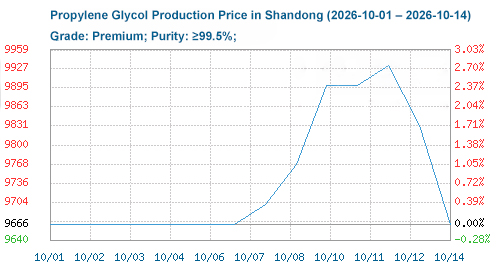
During the first half of October, propylene glycol prices trended upward with some volatility, supported by rising costs of its upstream feedstock, propylene oxide. However, as downstream demand remained weak and failed to show significant growth, this price increase was driven by costs rather than by demand.
Core driving factors
Cost side: Propylene oxide (PO) is showing strength, serving as the primary driver behind the current round of price increases.
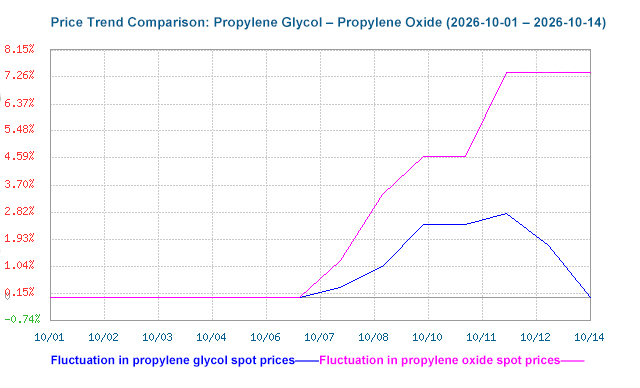
During the first half of October, prices for propylene and liquid chlorine trended upward, while propylene oxide (PO) quotes saw successive increases—rising by over 7%—following the holiday. This provided a clear cost floor for propylene glycol, strengthening the resolve of manufacturers to maintain higher price levels. However, with PO prices already at a high, downstream resistance to such elevated costs has emerged; consequently, the scope for further significant gains in PO is limited, and the marginal support from the cost side is expected to weaken moving forward.
Supply side: Reduced maintenance, with expectations shifting from tight to looser supply.
The tightness in spot supply—driven by maintenance at certain facilities in September—began to ease during the first half of October as these units gradually resumed operations and domestic operating rates saw a steady recovery. On the trading front, while manufacturers face little inventory pressure, stocks held by traders have begun to accumulate. The supply outlook has shifted from “tight” to “stable with an upward trend,” which limits the potential for further price gains. Although no new large-scale production facilities are coming online, the anticipated increase in supply from units resuming operations has dampened bullish sentiment in the market.
Demand side: Driven primarily by essential needs; the peak season has underperformed expectations, with no significant incremental growth.
- Unsaturated Polyester Resin (UPR): Operating rates remain low. End-user demand from the construction materials and fiberglass-reinforced plastic (FRP) sectors is weak; downstream manufacturers are purchasing only as needed rather than stocking up in advance, showing clear resistance to high prices.
- Antifreeze / Coolants: Although autumn is gradually arriving in the north, large-scale stockpiling of antifreeze has yet to begin. The market remains in a transitional phase, with no significant incremental demand as of yet.
- Personal Care, Pharmaceutical, and Food Grades: Demand is stable and driven by essential, ongoing consumption, with limited seasonal uplift.
- Exports: International market conditions are steady, with no notable surge in export orders; consequently, there is little positive impact on the domestic spot market.
Market Outlook: In the short term, propylene glycol (PG) prices are expected to fluctuate at high levels with a downward bias; a slight pullback is more likely, though any significant decline will be cushioned by cost support.
- Bullish Factors: If propylene oxide (PO) prices remain high, the cost floor for propylene glycol will hold, limiting the scope for a sharp decline. Additionally, the approach of the antifreeze stocking season in northern regions suggests a potential marginal increase in demand.
- Bearish Factors: The resumption of operations at previously idled or maintained units is increasing market supply. Meanwhile, downstream demand for resins remains weak, with buyers showing little appetite for high-priced material. Furthermore, traders are increasingly inclined to offload inventory when prices peak.
Post time: Oct-15-2026