
![Learn about one ingredient every day: [Propylene Glycol]-Market Analysis](http://cdn.globalso.com/jinchangshengchem/style/global/img/demo/page_banner.jpg)
Propylene glycol is an organic compound with the chemical formula C3H8O2, miscible with water, ethanol, and many organic solvents. Under normal conditions, it is a colorless, viscous liquid, nearly odorless, with a slightly sweet smell. Propylene glycol can be used as a raw material for unsaturated polyester resins and, in cosmetics, toothpaste, and soaps, can be combined with glycerin or sorbitol as a wetting agent.
Propylene glycol primarily functions as a hydrophilic and moisturizing agent for the skin. It is a colorless, transparent fatty alcohol with some viscosity and hygroscopic properties, found in ointments, masks, toners, cleansers, serums, and makeup removers. Its main function is to moisturize and retain moisture, and it is non-toxic and harmless to the skin, preventing excessive dryness.
However, if the concentration is too high, it may cause skin irritation, leading to redness, itching, and discomfort. Therefore, generally speaking, propylene glycol is usually beneficial and harmless to the skin when used at appropriate concentrations, but excessively high concentrations may cause skin irritation.
Propylene glycol market analysis
Recently, the propylene glycol market in Shandong Province has entered a new phase of competition characterized by weakening strong support and prominent weak demand. Market prices have softened, market sentiment has shifted from cautious observation to a bearish bias, producers have proactively adjusted prices, and the market center of gravity has moved downwards.
Supply side: From “structurally tight” to “expected easing”
The market supply pattern is undergoing dynamic changes. At the end of November, several shutdown plants, including Shandong Lihua Yiweiyuan and Tongling Jintai, restarted one after another, bringing actual supply increases. Coupled with the expected commissioning of new capacity from companies such as Fujian Baihong Chemical, this continued to suppress market sentiment, causing holders’ willingness to maintain prices to weaken.
Demand Side: Weak Domestic Demand Offers Limited Support
Downstream industries face the dual pressures of cash flow recovery and shrinking orders at the end of the year, failing to provide upward momentum for the propylene glycol market.
Unsaturated Resin (UPR): As the largest consumer of propylene glycol (accounting for over 50%), its performance has been sluggish. In the first half of December, the capacity utilization rate of the unsaturated resin industry was only 35%, a low level. Insufficient orders from end-user sectors such as construction and composite materials have led resin plants to maintain only minimal, essential purchases of raw material propylene glycol, failing to generate effective market demand.
Polyether polyols: Another major downstream sector also performed poorly, with a capacity utilization rate of about 58%, poor new order follow-up, and stable consumption of propylene glycol but lacking growth points.
Raw material cost side: propylene oxide (PO) support wavers.
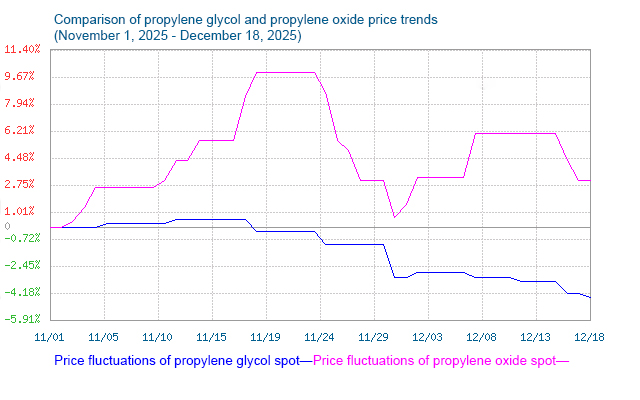
The price trend of propylene oxide (PO), a raw material, is key to influencing the cost of propylene glycol. In the first half of December, the PO market ended its previous sustained strong performance. Although the shutdown of plants such as Qixiang in Shandong initially provided a boost to market sentiment, weak demand from downstream polyethers hampered PO price increases, leading to a stalemate or even a slight downward trend. This resulted in a substantial easing of the production cost support for propylene glycol, providing producers with room to lower their prices, and shifting the cost-driven logic from “strong support” to “neutral to bearish.”
Market Outlook: Weak consolidation, bottoming out and fluctuating.
In the second half of December, market dominance will be entirely in the hands of the demand side. Cost pressures and fluctuations will struggle to provide an effective boost. Expectations of ample supply will exacerbate bearish sentiment. Without positive catalysts, the market is likely to remain at low levels, gradually exploring new price bottoms through a combination of declines and fluctuations. A stabilization and rebound may not occur until January 2026, depending on downstream restocking before the Spring Festival and the status of supply-side facilities.
Post time: Dec-19-2025