

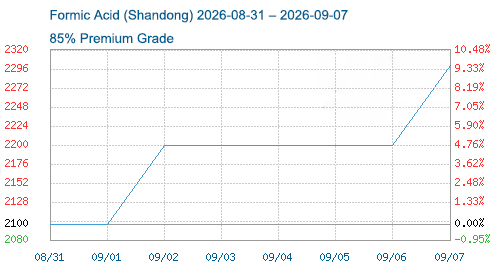
In early September, the domestic formic acid market exhibited a phased trend characterized by initial stability followed by a rise and subsequent consolidation at high levels; market fluctuations followed a clear pattern, and overall operations remained steady and orderly. At the start of the month, prices initially maintained the sideways trend seen at the end of the previous month before undergoing a definitive price hike driven by favorable cost factors. Subsequently, the market stabilized, supported by a balanced supply-demand dynamic, with no significant volatility; trading sentiment became more rational, and industry fundamentals provided solid support.
Favorable factors on the cost side are stimulating price increases.
Rising costs were the primary driver behind the upward movement of formic acid prices in early September. During the first ten days of the month, the prices of key raw materials—such as coal—continued to climb, shifting the cost baseline higher and directly increasing the comprehensive production costs for manufacturers. This sustained rise in costs disrupted the market’s previous stability, giving producers the confidence to proactively raise their quotes and successfully drive up spot prices. With raw material prices subsequently stabilizing, this cost-driven support persisted, providing a solid floor for the elevated formic acid prices and effectively eliminating the risk of a price pullback.
Dynamic balance between supply and demand
Supply and demand fundamentals have driven the market’s stabilization following the price increases. On the supply side, overall industry inventory levels for formic acid remain within a reasonable, moderate range; there is neither a backlog or pressure to destock, nor a shortage or critical depletion of supplies, indicating a healthy inventory structure. Manufacturers have maintained a steady pace of shipments, ensuring an orderly supply that meets normal market demand and lays the foundation for price stability. On the demand side, essential procurement by downstream end-users has proceeded steadily, free from surges in restocking or panic buying, and without any precipitous drop in demand. This solid support from essential demand has fostered a temporary dynamic balance between supply and demand, effectively curbing significant price volatility.
Overall, the formic acid market trend in early September aligns with the characteristics of the chemical industry’s traditional peak season onset, driven by a clear logic of cost-push price increases amidst stable supply and demand. Currently, bullish factors and stabilizing forces are balancing each other out; cost-side support remains firm, supply and demand are in equilibrium, and there is a strong industry sentiment favoring price maintenance. In the short term, the domestic market for 85% industrial-grade formic acid is likely to maintain its current high-level stability, with a very low probability of significant price fluctuations. Future market trends will depend primarily on raw material price volatility, the strength of the recovery in essential downstream demand, and changes in industry inventory levels; should costs continue to rise or downstream demand surge, there remains room for further price increases, though close monitoring of supply and demand dynamics is required.
Post time: Sep-09-2026