

Following the New Year’s Day holiday in 2026, the domestic acetone market reversed its sluggish trend of 2025, embarking on a strong upward trend driven by a concentration of positive factors. Prices rose significantly, market sentiment shifted from pessimism to optimism, and the industry landscape underwent a phase of reversal. Looking at market performance, the price of acetone in East China increased by 18.3% in just over 20 days, from January 1st to January 26th. During this period, factories in the industry simultaneously raised prices, further strengthening the market’s upward momentum and injecting strong confidence into the market.
Acetone price trend chart in East China
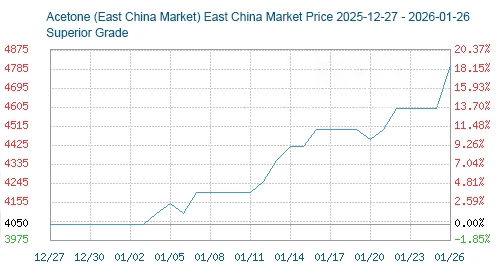
Domestic phenol and acetone plants have maintained a stable operating rate of over 85%, ensuring ample supply while managing pressure. Major plants have no significant inventory buildup and have been raising their acetone prices in rotation since January 5th, with a cumulative increase of 650-800 yuan/ton, directly driving the market upward. Prices in all regions have followed suit, with East China, as the mainstream region, experiencing the most significant fluctuations.
Port inventories showed a trend of “slight increase followed by decline,” with limited pressure to accumulate. Post-holiday arrivals of large Saudi ships led to a slight increase in inventory, but end-user purchases simultaneously increased, absorbing the supply. By January 19th, inventory had fallen to 28,000 tons, further reinforcing expectations of tight supply. On the import side, January saw 26,000 tons of acetone imports, with 12,000 tons already delivered and 14,000 tons en route. Subsequent shipments are mainly from South Korea and Thailand, with no concentrated arrivals planned, indicating no new supply pressure in the short term.
Solid support is provided from the cost side, with recent list prices for benzene and propylene increasing by RMB 200/ton and RMB 350/ton respectively, pushing up the overall cost of phenol and acetone. Affected by the transmission of rising raw material prices, the order prices for phenol and acetone have also increased by RMB 100/ton and RMB 250/ton respectively, effectively offsetting some cost pressures. It is expected that benzene and propylene prices will fluctuate in the short term, with the cost support situation continuing.
Demand is showing a structural divergence, with strong support from core sectors. The bisphenol A (BPA) industry’s operating rate rose to 67.49%, with steady growth in procurement demand; the MMA (methyl methacrylate) industry’s operating rate reached 64%, with Yulong Petrochemical’s new 100,000-ton unit scheduled to start production in February and acetone bidding already initiated, continuously boosting market expectations. The isopropanol and MIBK industries saw a decline in operating rates due to plant maintenance, but increased demand from core downstream sectors was sufficient to offset the drag, providing solid demand support for the market.
In the short term, the domestic acetone market will continue to fluctuate with a slightly upward bias. Supply pressure is manageable, cost support is firm, and core demand is improving, forming a combined force. Going forward, it is necessary to pay close attention to the price adjustment intentions of major factories, the transaction volume of terminal purchases, and changes in the start of production before the Spring Festival. In the long term, the market still has room for upward movement, but we need to be wary of the risk of correction caused by fluctuations in raw material prices and changes in the arrival schedule of imported goods.
Post time: Jan-27-2026